


Start with three numbers
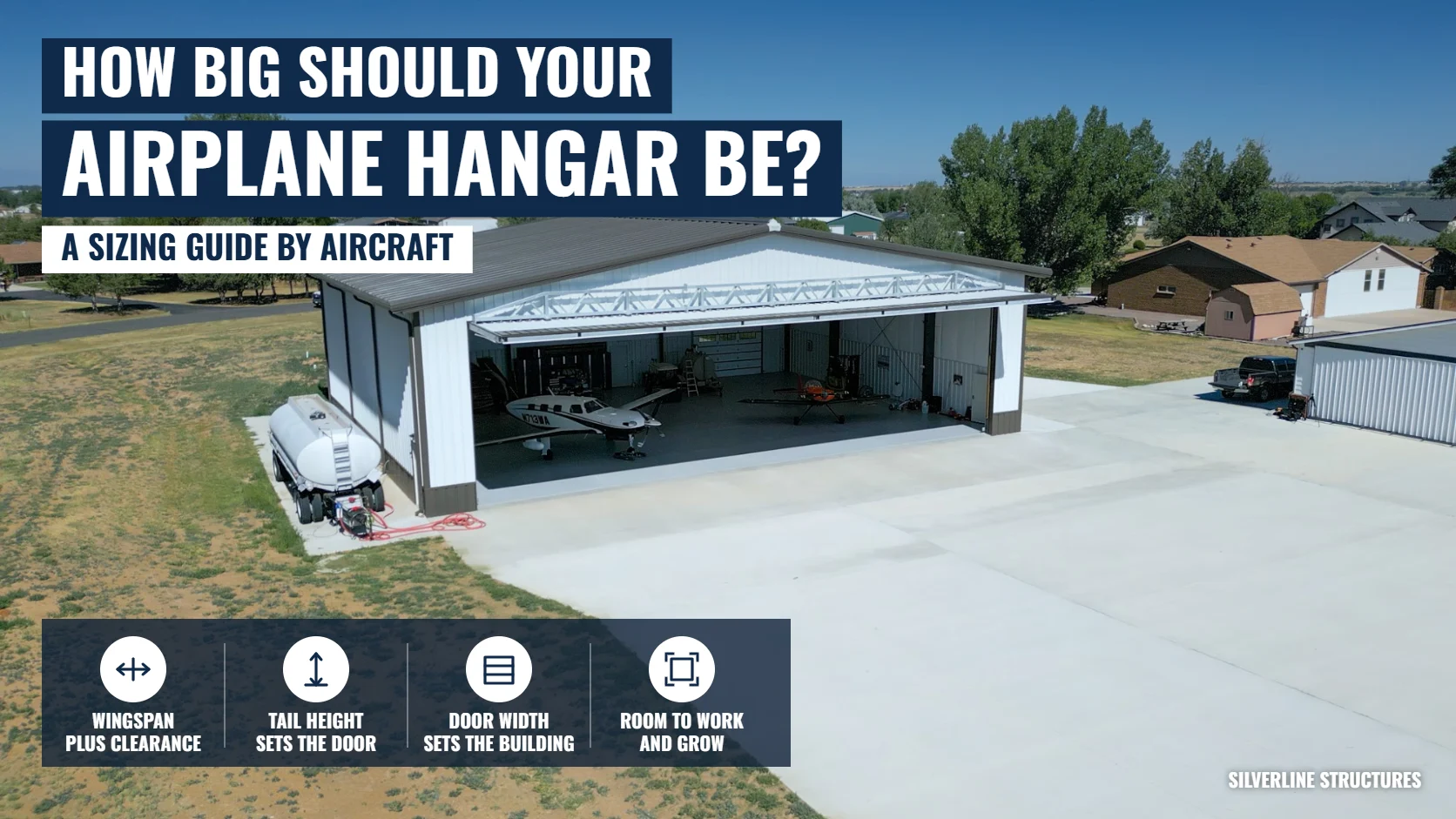
Every hangar is sized from the same three measurements: wingspan, tail height and door width. Wingspan sets the floor. Tail height sets the eave. Door width has to clear the wings with margin on both sides. Get those three right and the rest of the building, from the slab to the lighting, falls into place.
Wingspan sets the width
Take your wingspan and add at least 5 feet on each side. That gives you room to walk around the aircraft, open doors and cowlings and roll a tug or fuel cart past without touching a wingtip. If you store a tool chest, a golf cart or a second small aircraft, add more.
Typical wingspans and a sensible starting width:
- Cessna 172, Piper Archer (35 to 36 ft span): 45 ft wide
- Bonanza, Cirrus SR22 (33 to 39 ft span): 50 ft wide
- Baron, Seneca (38 to 39 ft span): 50 ft wide
- Pilatus PC-12, King Air 350 (53 to 58 ft span): 70 ft wide
Tail height sets the eave
The tail is the tallest point on most aircraft, and it has to clear the door opening, not just the roof. A Cessna 172 stands about 9 feet at the tail; a King Air 350 is closer to 15. Add 2 to 3 feet of clearance and you have your minimum door height. The eave height then needs to carry the door hardware above that. For most singles and light twins, a 14 to 16 foot eave works. Turboprops and jets push to 18 feet and beyond.
Depth: more than you think
Depth is the number people under-size. Measure nose to tail, add 5 feet in front and behind, then add space for everything else that ends up in a hangar: a workbench, a tug, fuel, a couch. A 40 foot depth suits most singles. 45 to 60 feet gives twins and turboprops breathing room.
Framing follows width
Up to 60 feet wide, cold formed steel is the lighter, faster choice. Above 60 feet, red iron (I-beam) framing carries the clear span with no interior columns. There is no column anywhere in a Silverline hangar, whichever frame you land on. See how the two compare on our building types page.
Planning for a second aircraft
If there is any chance of a second aircraft, size for it now. Widening a steel building later means new engineering, new foundation work and a door you have already paid for once. An 80 by 80 foot red iron hangar comfortably holds two singles or a single and a twin, with room for a shop along one wall.
Ready to size yours?
Silverline Structures builds custom steel airplane hangars across all 48 states, engineered to your aircraft and your site. See our airplane hangar page for standard sizes and framing options, or contact our team with your aircraft make and model and we will size it for you.
contact a design specialist
Work one-on-one with a metal building design specialist to design the perfect building
contact an expert